Top Color TFT LCD Screen Suppliers for Global Buyers
Choosing reliable Color Tft Lcd Screen suppliers requires more than comparing catalog prices. Global buyers must examine brightness, viewing angle, interface stability, touch performance, and long-term availability. A screen that looks excellent in a showroom may lose contrast under direct sunlight. It may also fail after repeated temperature changes.
Recent reports from Omdia and the Display Supply Chain Consultants (DSCC) show continuing demand for small and medium-sized display panels across automotive, industrial, medical, and consumer equipment. Their analysis also highlights pricing cycles, capacity shifts, and strong competition among Asian panel manufacturers. These factors influence lead times, minimum order quantities, and replacement planning. Market data helps, but it does not replace supplier verification.
Ross Young, co-founder and CEO of DSCC, has observed, “The display industry is cyclical, but display demand continues to grow over time.” That insight matters for purchasing teams. A low quote may not remain attractive when panel production changes. Buyers should request optical test records, sample approvals, aging results, and documented quality procedures. They should also confirm whether the supplier controls panel sourcing or only resells finished modules.
Experience often reveals the missing details. Check connector placement. Measure the cable length. Test the display with your actual controller. Small mismatches create expensive redesigns.
No supplier wins every application. Even experienced buyers can overlook sunlight readability or firmware compatibility. Therefore, this guide compares leading Color Tft Lcd Screen suppliers through measurable specifications, manufacturing capability, customization support, certifications, and after-sales reliability. The goal is practical selection, not an unrealistic promise of perfection.
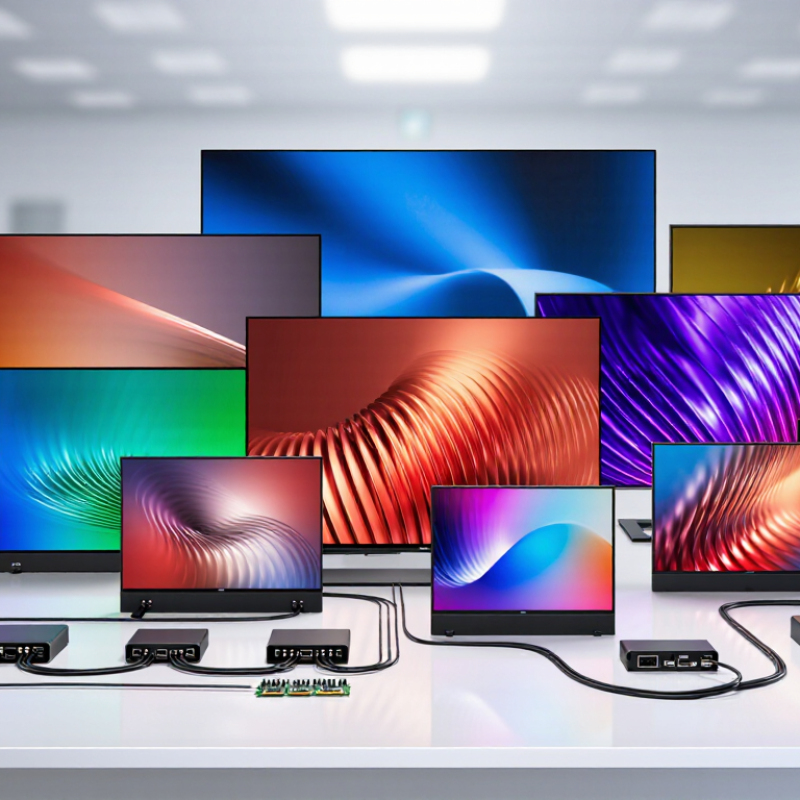
Global Color TFT LCD Supplier Landscape: Gen 5–10.5 Fab Capabilities
Global color TFT LCD sourcing now depends heavily on fab generation, not just quoted panel prices. Gen 5 and Gen 6 fabs often support monitor, notebook, automotive, and industrial display formats. Their smaller substrates can suit mixed-size production and frequent design changes. Gen 5 commonly uses substrates near 1,100 × 1,300 mm, although dimensions vary by facility. Gen 6 lines may offer better efficiency for medium-sized panels.
Gen 8.5 and Gen 8.6 fabs target larger televisions, commercial displays, and high-volume applications. Gen 8.5 substrates often measure about 2,200 × 2,500 mm. Gen 10.5 facilities can process substrates near 2,940 × 3,370 mm. These larger sheets improve glass utilization for big screens, but they do not automatically guarantee lower total cost. Cutting plans, yield, backplane design, and demand stability still matter.
Ask suppliers for evidence, not broad claims. Review monthly capacity, active-matrix technology, glass utilization, defect maps, and qualification records. Check whether color uniformity remains stable across the panel surface. A factory may report impressive capacity while allocating only limited production time to external buyers. That detail is easy to miss. Fab generation is also an imperfect comparison because equipment age, process control, and yield can differ widely. In my experience, a reliable sourcing decision combines fab capability with sample testing, traceable inspection data, and realistic delivery commitments. Availability changes quickly. Supplier validation must remain ongoing.
Core TFT LCD Specifications: 240–4K Resolution, 250–1,500 cd/m² Brightness
Global buyers often begin with resolution, but the correct TFT LCD choice depends on the product’s viewing distance and workload. A 240-pixel display may suit a compact industrial meter. A 4K panel can reveal fine maps, medical images, or control data. More pixels do not automatically create a better user experience.
Brightness usually ranges from 250 to 1,500 cd/m². Indoor equipment may work well near 250 cd/m². Sunlit transport systems often need 800 cd/m² or more. Outdoor readability also depends on contrast, anti-glare treatment, viewing angle, and cover glass reflections. Brightness alone is not enough. It can even increase power use and heat.
Experienced sourcing teams should request test conditions with every specification. Ask whether brightness is typical or minimum, and confirm uniformity across the panel. Check color depth, response time, operating temperature, backlight life, and interface compatibility. A 4K panel may require stronger processing hardware and a faster connection. That detail is easy to miss. Supplier reliability also depends on sample consistency, inspection records, packaging quality, and technical support across regions. A specification sheet can still mislead when measurements use ideal laboratory settings. Recheck performance under real lighting, with the intended cover lens installed. Some assumptions will fail. That is useful, because early correction costs less than replacing displays after production.
Top Supplier Evaluation: Viewing Angles Above 170° and 30,000-Hour Lifespan
When evaluating color TFT LCD suppliers, viewing angle should be tested, not simply advertised. A specification above 170° suggests strong image visibility from extreme positions. In practice, check color shifts at 85° from the center. Display a skin-tone image, a blue gradient, and small gray text. These reveal weaknesses quickly. A screen may remain readable while losing accurate color.
A reliable supplier should provide viewing-angle data for both horizontal and vertical directions. Ask for test conditions, brightness settings, and measurement methods. Factory samples should be inspected under office lighting and direct sunlight. This matters for control panels, transport displays, and outdoor equipment. Tiny labels can become unclear. That is a costly surprise.
A claimed 30,000-hour lifespan also needs careful review. Confirm whether this figure applies to the backlight, the panel, or both. Request test temperature, operating cycle, and brightness-retention data. Continuous operation at maximum brightness can shorten practical life. Heat near the display edge may create uneven illumination over time. I have seen attractive samples perform well initially, yet show weak uniformity after extended testing. That assumption can fail. Supplier reliability depends on traceable reports, stable production records, and realistic warranty terms. A useful evaluation includes repeated power cycles, vibration checks, and at least several weeks of observation before volume purchasing.
Top Color TFT LCD Screen Supplier Evaluation Benchmark
This supplier-neutral benchmark compares two core evaluation criteria for color TFT LCD screens: viewing angle and rated service life. A viewing angle above 170° supports stable image visibility from wide positions, while a rated lifespan of at least 30,000 hours indicates suitability for long-term commercial and industrial use. Actual performance may vary by panel design, operating temperature, brightness setting, and usage conditions.
Regional Manufacturing Comparison: China, Taiwan, Japan, South Korea, and Europe
China remains the largest manufacturing base for color TFT LCD panels. Omdia’s 2024 Display Long-Term Demand Forecast indicates that China produced over 60% of global LCD display area in 2023. Its advantages include large glass fabs, dense component networks, and competitive pricing. However, supplier quality can vary between factories. Taiwan offers stronger process consistency and flexible production for industrial, medical, and automotive displays. TrendForce reports that Taiwan remains a major supplier of medium and small-size panels, although its capacity is smaller than China’s.
Japan focuses on high-reliability applications, including instruments, transportation systems, and professional equipment. Production costs are usually higher. South Korea maintains advanced display engineering, but its LCD capacity has declined as manufacturers shift toward other display technologies. This can affect long-term LCD availability. Europe provides close technical cooperation, strict traceability, and shorter regional logistics for European buyers. Yet, local manufacturing capacity is limited, and unit prices may rise. These differences matter more than a simple price comparison.
Tips: Request panel lifetime data, brightness uniformity results, and temperature-cycle records. Check whether the quoted capacity is actual LCD capacity or planned expansion. A supplier may promise ten thousand units daily, but factory audits sometimes reveal lower practical output. That gap deserves careful review. The OECD’s 2023 semiconductor and display supply-chain analysis also supports regional diversification, because concentrated production creates delivery risks during disruptions. No region is perfect. Product use, service access, and replacement planning should guide the final decision.
Global Buyer Checklist: MOQ, ISO 9001, RoHS, REACH, Lead Time, and Warranty
For global buyers, a color TFT LCD supplier should pass a practical checklist before price discussions begin. MOQ matters because a low quantity can reduce inventory risk, but it may increase unit cost or limit customization. Ask for pilot samples, monthly capacity, and a written production schedule. Lead time should include glass, driver ICs, backlights, testing, and export preparation. A quoted “15 days” may not cover all stages.
ISO’s 2022 Survey recorded more than one million ISO 9001 certificates worldwide, showing its broad use as a quality framework. Still, certification alone is not proof of stable LCD performance. Request the certificate scope, audit validity, process-control records, and sample inspection data. RoHS evidence should identify restricted-substance testing, while REACH documentation should address SVHC communication and material traceability. The European Chemicals Agency updates SVHC information regularly, so old declarations deserve review.
Warranty terms need more detail than “12 months.” Confirm acceptable dead-pixel limits, brightness loss, color deviation, return procedures, and repair responsibility. Industry supply-chain reports repeatedly identify component shortages and logistics disruption as major lead-time risks. Build buffer time. It is easy to underestimate customs delays. One overlooked issue is temperature testing; displays used in vehicles or outdoor kiosks may need wider operating ranges than standard indoor panels._requirements should be recorded in a signed specification, not left in email conversations.
Top Color TFT LCD Screen Suppliers for Global Buyers - Global Buyer Checklist: MOQ, ISO 9001, RoHS, REACH, Lead Time, and Warranty
| Anonymous Supplier Profile | Typical TFT LCD Offering | Typical MOQ | ISO 9001 | RoHS | REACH | Sample Lead Time | Mass-Production Lead Time | Standard Warranty | Buyer Verification Focus |
| Profile A — Standard Consumer Display | 2.4–5.0 inch color TFT, 240×320 to 800×480 pixels, RGB or SPI interface | 100–500 pcs | Available upon request | Declaration available | Declaration available | 2–4 weeks | 4–8 weeks | 12 months | Confirm pixel-defect policy, touch-panel compatibility, and backlight lifetime. |
| Profile B — Industrial Wide-Temperature Display | 3.5–7.0 inch TFT, 480×272 to 1024×600 pixels, LVDS, RGB, or MIPI interface | 50–300 pcs | Available upon request | Declaration available | Declaration available | 3–5 weeks | 6–10 weeks | 12–24 months | Verify operating temperature, storage temperature, vibration testing, and production traceability. |
| Profile C — High-Brightness Outdoor Display | 4.3–10.1 inch TFT, 800×480 to 1280×800 pixels, high-brightness LED backlight | 30–200 pcs | Available upon request | Declaration available | Declaration available | 3–6 weeks | 8–12 weeks | 12 months | Confirm luminance specification, sunlight readability, anti-glare treatment, and LED lifetime rating. |
| Profile D — Capacitive Touchscreen Module | 5.0–15.6 inch TFT with projected-capacitive touch, cover glass, and optical bonding options | 20–100 pcs | Available upon request | Declaration available | Declaration available | 4–7 weeks | 8–14 weeks | 12 months | Check touch-controller compatibility, glove operation, cover-glass hardness, and bonding uniformity. |
| Profile E — Custom Medical-Use Display | 7.0–21.5 inch TFT, high contrast, stable color performance, custom mechanical integration | 10–50 pcs | Available upon request | Declaration available | Declaration available | 4–8 weeks | 10–16 weeks | 12–24 months | Request color-uniformity data, calibration records, environmental test results, and change-control procedures. |
| Profile F — Automotive-Style Display Module | 7.0–12.3 inch TFT, wide viewing angle, high brightness, LVDS or automotive-grade MIPI interface | 10–100 pcs | Available upon request | Declaration available | Declaration available | 5–8 weeks | 12–20 weeks | 12–24 months | Verify lifecycle commitment, electromagnetic compatibility testing, temperature cycling, and supply continuity. |
Buyer checklist note: MOQ, lead time, warranty period, certification status, and compliance documents are typical market-reference ranges for anonymous supplier evaluation. Obtain current certificates, declarations, inspection standards, and written commercial terms before placing an order.


 Phone
Phone WhatsApp
 Email
Email